Fleet fuel costs are one of the largest line items in school district and public sector budgets and when prices rise, the pressure to cut waste grows with them.
Read time: 8-min read
Summary: Fleet fuel costs are one of the largest line items in school district and public sector budgets and when prices rise, the pressure to cut waste grows with them. This guide breaks down where fuel waste hides, why it's hard to find without engine-level data and how fleet managers build a strategy that holds up to public scrutiny.
Fleet managers know fuel is one of their top three operating expenses. A significant portion of what they spend disappears in ways standard telematics tools can't see. When fuel prices spike, this becomes even more pressing.
Fuel waste in educational, vocational and public sector fleets doesn't look like one big problem. It looks like five smaller ones, each hiding in a different part of your operation. Understanding what's driving waste is your first step toward doing something about it. The primary factors
-
Idling waste
-
Reducing aggressive driving
-
Avoiding mechanical waste
- Automatically tracking tire pressure
- Reducing fuel theft
Why is fleet fuel waste so hard to find with standard telematics?
The core problem is data quality.
Most telematics systems estimate fuel consumption based on distance traveled. They take a GPS reading, apply an assumed fuel economy rate for the vehicle type, and report a number.
For a long-haul semi running consistent highway miles, that estimate is close enough. For a school bus making 40 stops before 8 a.m. or a utility truck idling at a jobsite for two hours, the estimate is off.
Waste hides in the difference between estimated and actual fuel consumption.
- A vehicle logged as burning 6.2 gallons per hour might be burning 7.8 gallons instead.
- A route that looks fuel-efficient in a summary report might be generating hundreds of avoidable idle events per week.
Unless your vehicles’ data is pulled directly from their Engine Control Unit (ECU), your decisions are based on approximations.
GPS estimates vs. ECU data
GPS-estimated fuel data applies a formula to distance traveled. ECU data reads what the engine burned.
The difference between the two can be significant, especially for stop-and-go duty cycles For school districts and public-sector agencies that are required to justify every gallon of fuel used to a board or taxpayers, only ECU data holds up under scrutiny.
Distinguish between necessary idling from waste
Conversations around idling usually stop at "turn the engine off." School bus drivers waiting, with 40 students on board, can’t do that while they wait at a railroad crossing in January. They have to keep the engine running to keep the heater going to keep the kids warm while the train passes.
The real challenge is distinguishing necessary idling from waste.
According to the Ecology Center, unnecessary idling consumes 3.8 million gallons of fuel per day across the U.S. Engines often run for legitimate reasons, including running the A/C or heater for student safety, waiting at school for dismissal and pre-trip warmup for the engine if it’s cold outside.
But those same operational needs also cover a lot of unnecessary idling, such as warming up the engine for too long. The U.S. EPA recommends no more than three to five minutes of idling to warm up a school bus engine, a baseline most fleets exceed regularly without realizing it.
Without time-stamped, location-specific idle data, you can't tell the difference between acceptable and unacceptable engine-on time. Without knowing exactly, based on data, what was necessary and what wasn’t, any conversation with a driver about idling becomes a general complaint rather than a specific, coachable moment.
Focus on understanding which idle events serve an operational purpose and which don't. Fleets besides isn't unique to school buses have the same issues with idling waste.
-
Field service such as HVAC or electrical services trucks and vans run at job sites for hours to power equipment or wait between calls.
-
Municipal and public works vehicles idle through work zones and staging areas in ways that feel routine until the cost of that routing idling is calculated across the full fleet.
Duty cycles differ, but the problem is the same: you need data on idle location and duration, to separate necessary engine-on time from waste and change driver and operator behavior.
Categorizing idle events by location, duration and time of day using your fleet management software's idle report shows the distinction between useful idling and wasteful idling.
-
Idling at a school 20 minutes before the bell is different than idling at a depot with no students on board.
-
A two-minute idle at a crossing is operationally defensible. A 45-minute idle parked at a driver's house is not.
Driver behavior can be coached
According to the U.S. Department of Energy, aggressive driving reduces fuel efficiency 15 to 30% at highway speeds and 10 to 40% in stop-and-go conditions.
The term “aggressive driving” by itself can be hard to quantity. Throttle management is more specific and useful, specifically how a driver applies acceleration relative to what the route and load require.
-
Hard acceleration from a stop burns more fuel than gradual acceleration to the same speed.
-
Frequent braking followed by hard acceleration, both of which are common in stop-and go routes, add up.
-
Over hundreds of route cycles, small differences in throttle behavior translate to thousands of dollars in fuel spend.
A driver told "you're using too much fuel" has nowhere to go with that feedback. A driver shown "on Route 14, your fuel economy drops 18% between Oak Street and the high school due to acceleration patterns at three specific intersections" has something actionable. That specificity requires engine-level data read directly from the ECU.
Drivers who understand why their behavior affects fuel economy and who realize that their performance is being actively measured, will change it more durably than drivers who are simply told to change it based on unmeasureable opinion.
Avoid mechanical waste
Not all fuel waste is behavioral. Some of it lives entirely in the vehicle and remains invisible until it becomes expensive. Examples? Dragging brakes, clogged fuel filters, dirty fuel injectors and failing emissions components. Drivers won’t notice a change in performance until any one of these issues degrade fuel economy too much to ignore. A vehicle running 8 to 12% below its expected fuel efficiency because of a mechanical issue looks, from the driver's seat, like a normal day of driving.
The gap between GPS-estimated fuel data and engine-level data is most visible here. A telematics system that estimates consumption from distance traveled will show that vehicle as performing normally. A system reading directly from the ECU will flag the discrepancy between expected and actual fuel burn, and fault codes point to the specific mechanical cause. The Department of Energy reports that fixing a serious maintenance problem, such as a faulty oxygen sensor, improve fuel mileage by as much as 40%.
Fuel economy data, not just mileage intervals, should be part of the diagnostic conversation. Whether the vehicle needs maintenance or the driver needs coaching, the trend is worth investigating before it becomes a repair bill.
Track tire pressure automatically
Tire pressure is a simple, controllable, mechanical variable. And its impact on fuel economy is real and ongoing.
According to the U.S. Department of Energy, fuel economy drops approximately 0.2% for every 1 PSI a tire falls below its recommended pressure. That’s just for a single PSI. A tire running 10 PSI below the recommended pressure reduces fuel economy by roughly 2% on that axle. And that level of underinflation is common for vehicles whose tire pressure isn’t checked every day.
For a 50-vehicle fleet running daily routes, persistent under-inflation across even a portion of the fleet costs a significant, but preventable, fuel waste expenses.
The challenge many fleets face is how often they check their vehicles’ tire pressure. Everyone is busy and other priorities always seem to take, well, priority.
Manual tire pressure checks are easy to defer, easy to skip under time pressure and easy to do inconsistently. Systematic monitoring is more reliable for catching pressure drops before they add up. It also creates a maintenance record that documents when tires were checked, flagged and their inflation was properly adjusted.
This approach also creates the kind of paper trail that matters when justifying operational spending to a school board or city council.
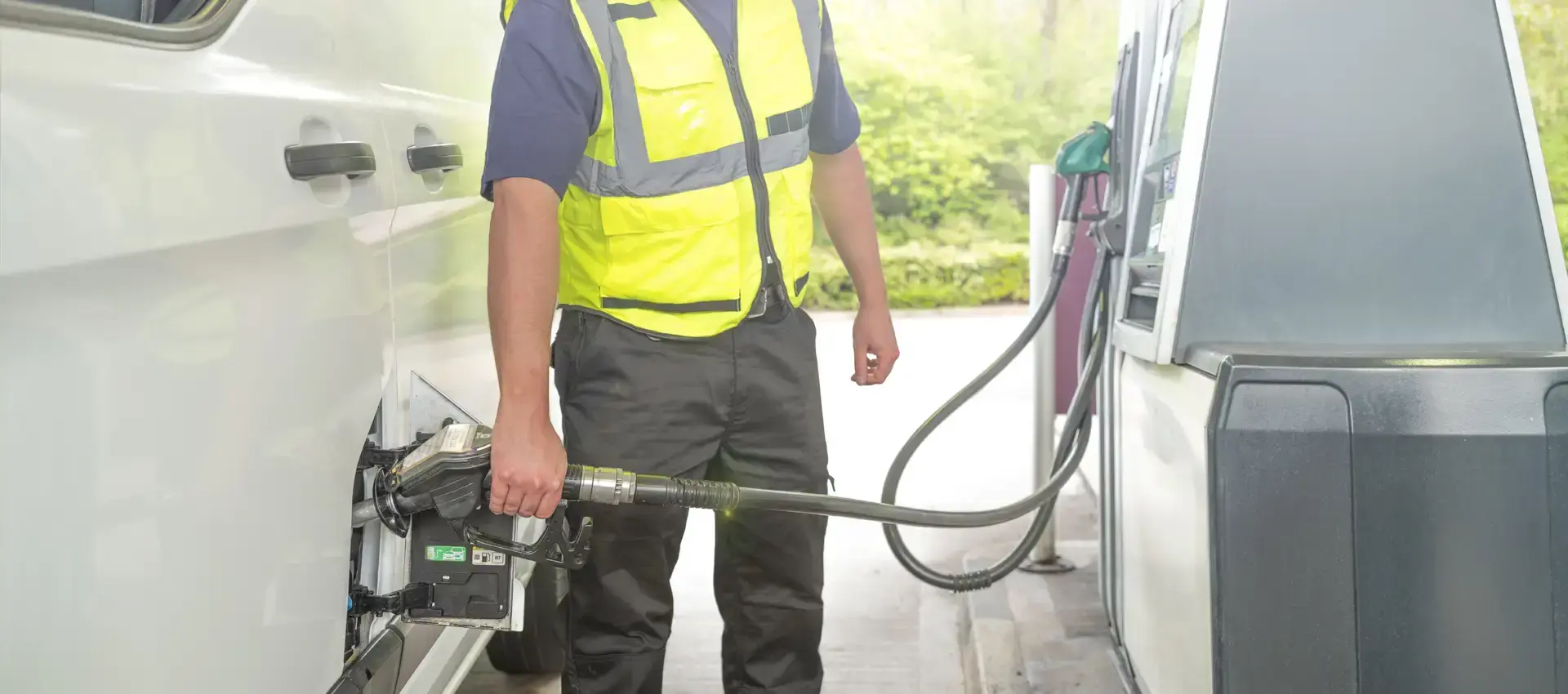
Track and deter fuel theft
Fuel theft in fleet operations is typically more structured and hidden than someone siphoning a tank at night.
-
Using fuel cards outside of authorized routes
-
Vehicle movement and location not matching fill-ups
-
Buying fuel for a fleet vehicle but actually fueling a personal one
Shell Fleet Solutions research found that fleets lose up to 5% of their annual fuel spend to misuse. And over 70% of fleet managers surveyed said reducing these costs is a top priority.
Misuse and theft persist because they're hard to detect without the right cross-referencing. An isolated fuel card transaction looks legitimate and only looks out of place when cross-referenced with the vehicle’s actual location during the time of purchase. Factor in calculations for how much fuel it would have needed based on how many miles it was drive, plus whether the fill-up time and location are consistent with the assigned route.
Manual audits catch obvious cases. They rarely catch patterns. And they can’t provide the same foundation for detecting misuse as understanding your fleet’s fuel purchasing patterns at the transaction level.
If you want to deter fuel theft and misuse, know which vehicles consistently show a gap between their fuel purchased and how many miles they’re driven.
Why does this hit school and public sector fleets differently?
For-hire trucking carriers have a lever most public fleets don't. They raise rates or attach fuel surcharges to offset what they spend at the pump.
Public fleet fuel budgets are set. Routes are fixed. The board meeting is next month.
A school bus or a municipal utility truck doesn't operate like a highway semi. It starts and stops dozens of times a day. It idles, sometimes necessarily, sometimes not. A school bus must stay running while students embark and disembark, and this is necessary part of every route. Many telematics tools use GPS-based distance estimates to calculate fuel consumption, which is inaccurate for stop-and-go operations.
That means the fuel data you're looking at may not reflect reality. And if it doesn't, you can't make a credible case to your board, your budget office or a public auditor that you've done everything possible to manage costs.
The answer sometimes defaults to a manual audit or a reminder to turn engines off. There's a better option.
Data pulled directly from the engine control module gives managers the evidence to make strategic decisions about fuel usage, and it's the only data that holds up under scrutiny.
Should rising fuel costs push your fleet toward EVs?
Fair question, and a complicated one. Higher fuel costs have renewed interest in EV adoption across commercial and public sector fleets. But they've also created the kind of budget uncertainty that makes large capital decisions harder to defend.
Federal EV infrastructure funding (NEVI) has been cut by $900 million, and uncertainty around charging grants continues to slow public sector fleet planning. Right now, that uncertainty is doing more damage to EV confidence than cost alone, according to fleet industry analysts.
You don't have to choose between managing today's fleet and planning tomorrow's. The data you generate through consistent fuel management, including consumption per vehicle, idle time and cost per mile, is the foundation a business case for EV transition needs. Vehicles with the highest fuel spend and the most predictable routes are your strongest candidates for electrification. Fleet managers who track that data carefully today are building the EV business case at the same time.
How do you build a fleet fuel strategy that holds up to board scrutiny?
School districts and municipalities answer to boards and taxpayers in a way private carriers don't. Every gallon burned is a public dollar. When fuel costs spike, for any reason, the question boils down to: "Can you prove you weren't wasting it?"
Engine-level data from a telematics control unit answers that question. GPS-based fuel reporting can't.
A defensible fuel management strategy includes:
-
Actual ECU fuel consumption data, not GPS estimates, reported by vehicle, route and driver
-
Idle time reports with contextual data to separate necessary from unnecessary engine on time
-
Fault and diagnostic data that connects mechanical health to fuel efficiency
-
Fuel monitoring that cross-references fueling activity against vehicle location and movement
-
A documented history of data-backed operational changes and evidence that the data led to action
When fuel prices are volatile, that infrastructure of good fleet management is how you meet the standard your stakeholders expect.
Zonar tools for fleet fuel management
The strategies in this guide rely on engine-level data pulled directly from the vehicle's ECU. Zonar's V4™ Telematics Control Unit is the hardware that makes that data available across the fleet. From there, tools like ZFuel (driver behavior and throttle analysis), FaultIQ® (mechanical diagnostics), idle monitoring in Zonar Ignition™ and tire pressure monitoring all work from that same data layer, giving fleet managers a connected view of where fuel goes and where it's being wasted.
Ready to see how Zonar helps reduce your fleet fuel costs?
Zonar has a hardware and software ecosystem that gives fleet managers the precise data needed to find waste, defend budgets and build toward a smarter fleet. Talk to a Zonar expert today.
Additional reading
External
-
U.S. EPA -- School Bus Idle Reduction
-
U.S. DOE -- Driving More Efficiently (fueleconomy.gov)
-
U.S. DOE -- Factors That Affect Fuel Economy (fueleconomy.gov)
-
Ecology Center -- Anti-Idling
-
Shell Fleet Solutions -- Fuel Fraud Prevention via Automotive Fleet
-
WEX -- Fleet Economics and Operations Outlook 2026
Internal Zonar resources