In any given year, there may be more than half a million crashes involving large trucks, according to the Federal Motor Carrier Safety Administration (FMCSA). In the most recent reporting period, the FMCSA reported 4,479 fatal crashes and 114,000 crashes involving injuries.
Several studies cited by the Insurance Institute for Highway Safety (IIHS) found that 40% to 60% of large trucks involved in crashes had at least one mechanical violation that contributed to the incident.
Pre- and post-trip inspections are a critical part of every driver’s routine. They help keep vehicles safe, reduce the risk of accidents, and support compliance with federal regulations.
Driver Vehicle Inspection Reports (DVIRs)
At the end of each workday, a driver must complete a driver vehicle inspection report (DVIR) and submit it to the home terminal. The driver must inspect both the power unit and trailer for deficiencies and record any issues on the report. If a driver identifies a problem, the carrier is required by law to repair defective or missing parts and accessories before the vehicle is allowed back on the road.
The motor carrier or its agent must also certify in writing that the necessary repairs have been made and the defects have been corrected.
DVIRs are required under FMCSA regulations in sections §396.11 and §396.13.
DVIRs are the standard reports drivers file after completing mandatory inspections. Many fleets now use electronic DVIRs, or eDVIRs, which make reporting and recordkeeping easier. With an eDVIR, drivers can submit inspection results immediately after the inspection is complete.
Both paper DVIRs and eDVIRs have limitations.
With paper DVIRs, forms can be lost, misplaced, damaged, or delayed. Even reliable drivers can forget to turn in paperwork at the end of a long shift. When maintenance issues are not reported promptly, they can go unnoticed and create avoidable safety risks.
An eDVIR system improves the workflow by capturing inspection data digitally and making it available for review right away. This simplifies repair scheduling and follow-up. Drivers can also attach photos to document issues more clearly.
Still, both methods depend on the driver to complete the inspection thoroughly. If a form is rushed or “pencil whipped” without a true inspection, problems can be missed and safety issues can follow.
Electronic Verified Inspection Reporting (EVIR)
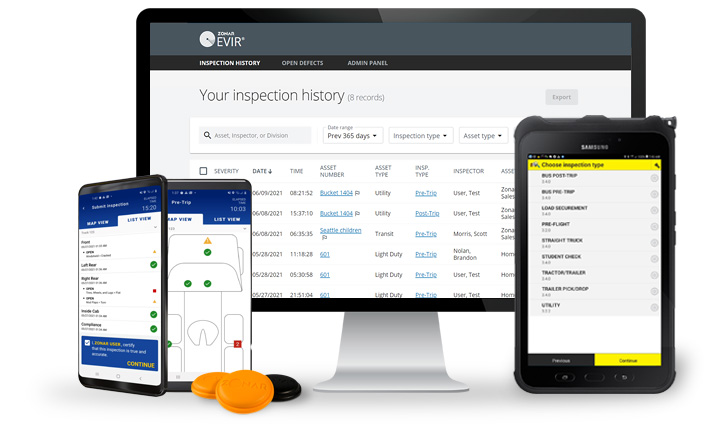
Zonar EVIR is an electronic verified inspection reporting system designed to make inspections verifiable. Unlike DVIR and eDVIR processes, EVIR is built to confirm that inspections are actually completed in the field.
That means inspections cannot be rushed through or checked off without completing the required steps.
When drivers skip inspection steps, they may miss issues that later lead to breakdowns, violations, or accidents. Even when those issues do not cause a crash, they can still be identified during one of the 2.5 million roadside inspections performed each year. The FMCSA estimates that these inspection programs prevent 14,000 accidents and 9,000 injuries annually.
During roadside inspections, more than 30% of vehicles inspected are placed out of service. Inspectors record 3.9 million violations each year, contributing to an estimated $270 million in lost revenue from fines, downtime, and service interruptions.
Many of these issues could have been caught earlier. With traditional DVIR and eDVIR methods, it is still possible for a driver to remain in the cab and simply check the boxes. EVIR requires the driver to visit each inspection zone and verifies that the inspection took place.
How EVIR Works
With EVIR, radio-frequency identification (RFID) or near-field communication (NFC) tags are placed in designated inspection zones on the vehicle. These tags are digitally linked to the specific asset, which confirms the vehicle’s identity and automatically loads the correct inspection information.
Drivers must physically visit each inspection zone and scan the RFID tag using a mobile device. They cannot complete the inspection without going to each required point. Because each scan is time-stamped, fleets can also identify inspections that were completed too quickly and review how long drivers spent in each zone.
For fleets that cannot use RFID tags, such as leased or rented equipment, drop-and-hook operations, or intermodal equipment, EVIR can also be used in tagless mode. Drivers follow the same inspection process, upload the information through a secure portal, and electronically verify and certify the results.
In addition to helping fleets complete pre- and post-trip inspections more effectively, EVIR creates a digital audit trail for reporting, accountability, and repair coordination. Drivers can receive alerts when repairs are completed and vehicles are ready to return to service, and fleet teams can review both current and historical inspection records.
Connected Fleet Management Tools
Zonar offers a range of fleet management tools that support safer and more efficient operations, including EVIR verified inspections, a fleet management platform, fuel efficiency tracking, and fleet driver tablets.
To learn more about how connected fleet solutions can improve safety, efficiency, and compliance, contact Zonar.