Summary: A school bus tracking app turns "where's the bus?" into a solved problem, giving parents real-time visibility into pickup and drop-off, districts a direct line for delay updates, and everyone fewer calls, faster communication, and a more predictable day, all without compromising student data security.
Read time: 9-min
Originally published on January 25, 2022, by Erica Wall. Updated August 24, 2026.
A school bus tracking app gives parents real-time visibility into their child's bus location and safe pickup or drop-off, while giving districts a direct channel to send delay and route updates. All of this comes with student rider information kept secure and access-controlled. The result: fewer dispatch calls, faster communication during disruptions and a more predictable daily routine for everyone involved.
Why school bus tracking has become essential for today's districts
Riding the school bus is different than when many of us were students. For one thing, deploying and routing buses on the fly due to changing school schedules and ongoing bus driver shortages makes each day less predictable (in fact, 81% of school administrators report an ongoing shortage of school bus drivers). For another, family life has grown busier and more complex. Parents and caregivers need to know when the bus will arrive so they can juggle work, obligations, child care, split households and after-school activities accordingly.
What hasn’t changed is a parent’s need to know their child is safe. On top of daily headwinds, many school transportation departments and dispatchers are overwhelmed with calls from parents looking for the bus. With widespread labor and staffing shortages, you probably don’t have the same number of people to shift around to field calls; maybe no one’s available at all.
A school bus tracking mobile app acts as a dedicated parent app, easing pain points for everyone involved by introducing a new line of communication.
How school bus tracking apps benefit parents and districts
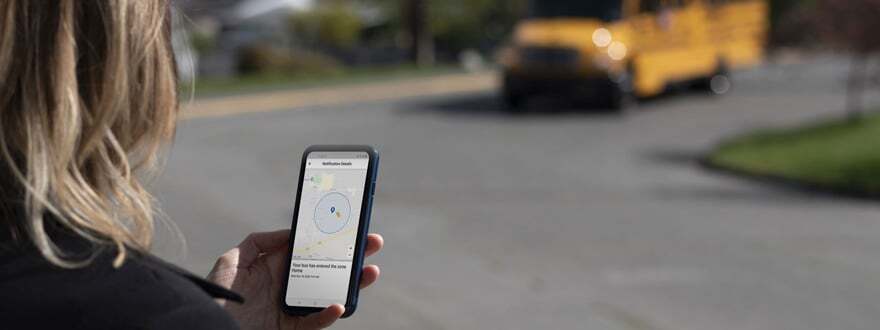
A school bus tracking app for parents lets them locate their child’s bus in real time by following a live bus icon on a map, the same way they’d track a food delivery. With roughly 26 million students riding a school bus daily in the U.S., that kind of visibility matters at scale. School bus tracking apps give parents independent visibility into their child's ride while providing districts with a built-in tool to reduce dispatcher calls.
-
Track the bus's location on their smartphone or tablet.
-
Check if their child got on and off the bus safely.
-
Be there for drop off so younger students aren't left unsupervised.
-
Eliminate waiting at the bus stop, especially outside in inclement weather.
-
Avoid missing the bus by knowing exactly when it will arrive, so there's no last-minute scrambling to get the child to school.
-
Plan a smoother day around the bus's arrival time.
-
Know when there’s a bus substitution or delay. Some systems, like Zonar Z Pass®, confirm this automatically via a student card read at boarding and exit, rather than relying on driver head counts alone.
Your office has power on the back-end, too. When a bus runs late or drifts off its route, dispatchers see it as it happens, not after a wave of parent calls. From there, staff reassign a driver, split a route, or message parents directly, all from the same screen, before a small delay turns into a flood of "where's the bus" calls. That shift from reactive to proactive is what actually reduces dispatcher workload.
-
Send timely alerts and notifications.
-
Notify them about schedule and route changes.
-
Push alerts when the bus is delayed or broken down.
-
Communicate day-of delays and early dismissals.
-
Support multi-home, co-parenting families, cancel-a-ride requests and afterschool schedules.
-
Message all parents or parents of children associated with specific buses or routes.
How do school bus tracking apps keep data secure?
Student safety and security are always top priority. Your bus tracking app needs to keep student rider information secure while providing parents control over access to their child’s rider information. For instance, Zonar Bus Suite relies on a unique access code to the custodial contact for each student. The parent enters their child’s unique district ID to track only that child’s bus. Additional password protection locks down all information and controls access.
Why parents and districts oversight needs different levels of detail
Districts and parents need different views of the same data. For districts, this goes beyond real-time GPS visibility: the same data used to track buses is also used for route planning, optimizing stop times, providing drivers with turn-by-turn directions and adjusting runs on the fly as conditions change. Parents don’t need any of that; they only need to see their own child’s bus and stay informed of relevant changes. Bus tracking apps are built to serve both needs at once, giving each side exactly the level of detail it requires. No more, no less.
For nearly two decades, schools and districts across the U.S. have been using GPS to track every bus in their fleet. Technology and the Internet of Things (IoT) have advanced over the years, so you can now monitor and manage every bus in real time and in detail.
Parents only need to track their child’s bus and stay informed of relevant changes. You don’t want them to have your level of insight into your other buses and their riders. Parents also want to be sure their child’s information remains secure. All reasonable expectations.
What parents need in a bus tracking app
Parents need six core features from a bus-tracking app: real-time location updates, cross-platform availability, ease of use, customizable alerts, clear communication and data security.
-
Ability to track their child's bus in real time, on their smartphone or tablet
-
App availability on Android and iOS, so they can use their favorite, everyday devices
-
Easy, intuitive interface, so they use it with a minimal learning curve
-
Flexibility to set alerts and notifications, customize tracking options and get visibility into whether their child got and off the bus safely
-
Clear communications from the school when there's a change
-
Peace of mind knowing their child's information is secure from unauthorized access
What schools and districts need in a bus tracking app
Schools and districts need a bus tracking app that reduces call volume, communicates efficiently and protects student data. All while being easy to roll out and support.
-
Ease-of-use and transparency for parents, so that call volumes are reduced
-
Turn-by-turn directions via a dedicated driver app to help them run routes accurately, including substitutions and detours
-
Ability to securely track student ridership, for example, through automatic card-based check-in/check-out systems like Zonar Z Pass®, which log boarding and exit without relying on manual head counts
-
Back-end portal that serves to communicate bus changes, delays and breakdowns
-
App availability on Android and iOS to serve a varied community base
-
Is implemented quickly and with minimal disruption
-
Flexibility to set up zones around schools and seamlessly manage bus substitutions
-
Ability to send one-way messages to appropriate parents regarding route changes, delays and emergency updates
-
Resources to help parents with basic questions about the app and their account
-
Secure parent and student information privacy
-
Ability to securely track student ridership
-
24/7/365 customer support
-
Reliable GPS hardware built for daily wear and tear, since accurate tracking is only as good as the hardware behind it
Taken individually, these look like a feature checklist. In practice, they only work well when they come from a single connected system rather than from separate tools bolted together. Otherwise, data gets out of sync and staff end up doing the reconciling work the app was supposed to eliminate.
Next steps: See how Zonar Bus Suite reduces parent calls
Reducing parent calls starts with giving parents a self-service way to track their child's bus. That's just one of the things Zonar Bus Suite handles. Built as a single routing and safety system, Bus Suite covers parent communication alongside routing, GPS and ridership, offering an integrated alternative to traditional platforms so the information parents need and the tools your team relies on come from the same place.
Running a school bus fleet means managing constant unpredictability: more buses, more students and more daily variables than most parents realize. Parents may not know everything that goes into it, but most understand it's a hard job. Even so, they still need one thing above all: to know where their child's bus is.
More buses, students and daily uncertainty mean more potential for surprises for everyone. Although parents may not know what it takes to run a school bus fleet, many of them understand that your job is difficult. Still, they also need to know where their child’s bus is.
Take a short moment to learn more about Zonar Bus Suite, our unified routing and safety system for student transportation. Find out how it brings the tools above (parent communication, real-time tracking and back-office visibility) into a single platform, so less falls through the cracks for your team and parents. It also means one call when something needs attention, instead of tracking down separate vendors for hardware, software and support.
When you’re ready, contact us to speak with an expert.