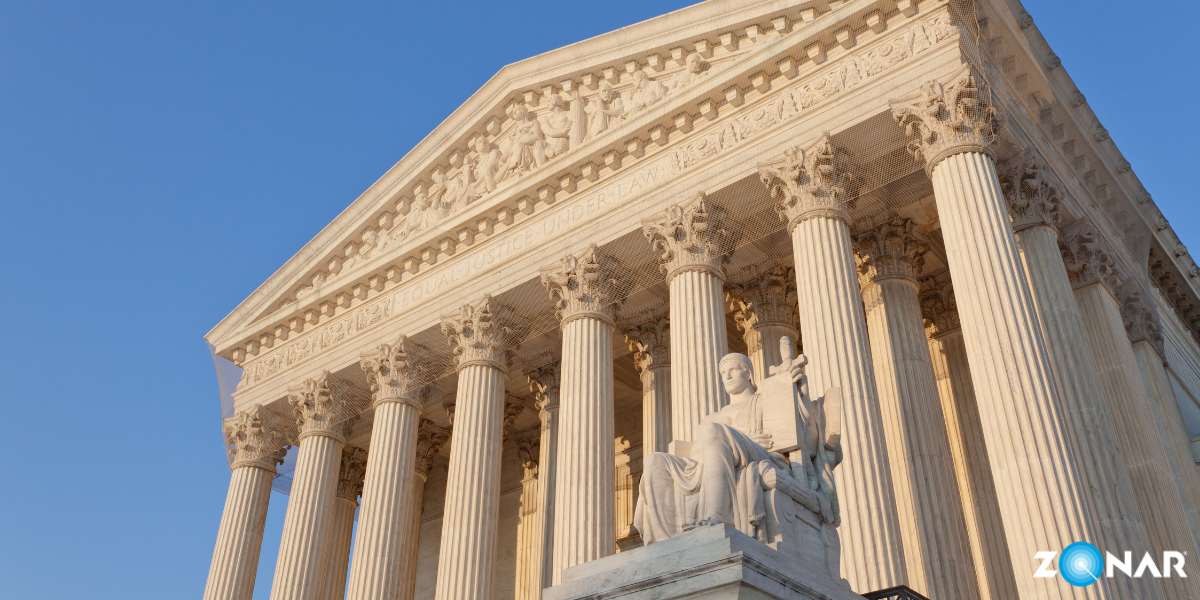
On May 14, 2026, the Supreme Court ruled 9-0 that freight brokers can be sued under state law for negligent hiring when they select unsafe carriers.
Read time: 6 minutes
Summary: On May 14, 2026, the Supreme Court ruled 9-0 that freight brokers can be sued under state law for negligent hiring when they select unsafe carriers. For fleet managers working with subcontracted drivers, the standard has changed. Now you must document your vetting decisions, or carry the exposure.
Legal disclaimer: This article summarizes the Supreme Court's ruling in Montgomery v. Caribe Transport II, LLC and its potential implications for fleet operations. It is for informational purposes only and does not constitute legal advice. Consult a qualified attorney before making compliance or contracting decisions based on this content. This article was last reviewed May 21, 2026. Before making a decision, be sure to check the latest updates on this subject.
On May 14, 2026, the U.S. Supreme Court issued a unanimous 9-0 ruling in Montgomery v. Caribe Transport II, LLC stating that negligent hiring claims against freight brokers are not preempted by federal law.
But what does that mean? The decision removes the legal shield that freight brokers, and other related industries, have relied on for decades to get cases in which there are safety claims dismissed before they reached a jury.
If your operation uses subcontracted drivers or third-party carriers, this ruling affects you. The Supreme Court’s reasoning extends beyond licensed freight brokers to third-party logistics (3PLs), freight forwarders, and anyone who selects a motor carrier and has access to publicly available safety data.
This means that moving forward, fleet managers need the kind of documented, data-driven safety programs that hold up when decisions get scrutinized.
Here’s what every fleet manager needs to know.
Key takeaways
- The Supreme Court’s ruling eliminates the federal preemption shield brokers used to block negligent hiring claims for safety-based cases.
- The ruling’s logic extends to 3PLs, freight forwarders, and any operation that selects a motor carrier with access to public safety data.
- “Knew or should have known” is the enforceable legal standard: FMCSA safety ratings, CSA scores, and inspection histories define what you’re expected to know before dispatching a carrier.
- Documented vetting decisions, verified inspection records, and driver behavior data are must-have practical defenses.
How did we get here?
The case traces back to Dec. 7, 2017, when truck driver Shawn Montgomery pulled his truck onto the shoulder of Illinois Interstate 70 due to a mechanical issue. A tractor-trailer driven by Yosniel Varela-Mojena, hauling a load of plastic pots for Caribe Transport II, veered off the road and struck Montgomery’s parked vehicle. According to the SCOTUS blog case preview, Montgomery lost part of his leg.
The load had been brokered by C.H. Robinson, one of the country’s largest freight brokers. According to the Legal Information Institute case summary, Montgomery’s lawsuit alleged Robinson knew, or should have known, that Caribe Transport II carried a “conditional” safety rating and had documented driver-qualification failures before the shipment was arranged.
The 7th Circuit dismissed the claims, ruling that the Federal Aviation Administration Authorization Act (FAAAA) preempted state tort claims against brokers. The Supreme Court reversed that decision unanimously.
Which, in plain language, means that the federal government had a law on the books that told states to back off regulating the trucking industry. A lower court ruled that law applied here, so Montgomery couldn't sue C.H. Robinson in state court at all, and the case was thrown out before a jury heard it.
What did the Court decide?
Justice Amy Coney Barrett, writing for a unanimous Court, held that negligent hiring claims fall within the FAAAA’s safety exception, which preserves states’ authority to regulate motor vehicle safety.
As the SCOTUS blog reported, the FAAAA was designed to deregulate trucking economics including prices, routes and services. Safety was always a different matter. Because negligent hiring claims concern the vehicles actually operating on the road, they belong to state regulators and state courts.
Justice Kavanaugh, joined by Justice Alito, wrote separately to note the ruling does not open brokers to automatic liability.
This is important: Brokers who document their carrier-selection decisions and exercise ordinary care remain protected. The ruling removes the metaphorical escape hatch that allowed brokers to get these cases dismissed before trial. Exercising and documenting ordinary care remains a full defense.
Key things the ruling established
- Negligent hiring claims against freight brokers are not preempted by the FAAAA.
- The FAAAA’s safety exception preserves state authority to regulate motor vehicle safety.
- The duty of ordinary care in carrier selection is now an enforceable legal standard.
- Brokers and intermediaries who vet carriers carefully and document those decisions retain a solid defense.
Does this reach your fleet?
The most important thing to understand is that the ruling’s logic extends far beyond licensed freight brokers.
As FreightWaves noted in its analysis, the opinion was written about C.H. Robinson because C.H. Robinson is a broker. But the principle applies to anyone in the supply chain who selects a carrier and has access to publicly available safety data showing elevated risk.
The Court’s standard is about the duty of ordinary care in carrier selection.
3PLs, freight forwarders, and fleet managers who dispatch subcontracted carriers all make carrier-selection decisions. And as Matthiesen, Wickert & Lehrer noted in their post-ruling analysis, the FAAAA preemption defense intermediaries relied on to block negligent hiring claims before trial is now substantially weakened.
Fleet managers who assumed a 3PL layer would insulate their operation from this liability need to revisit that assumption.
Questions to ask about your subcontracted carrier process
- Do you check FMCSA safety ratings and CSA scores before every carrier engagement?
- Do subcontracted carrier agreements require review of driver-qualification files?
- Does your team document carrier selection decisions in writing?
- Do your carrier agreements address subcontracting terms explicitly?
- Has your insurance coverage been reviewed since May 14, 2026?
Best practices
- Check publicly available FMCSA safety ratings, CSA BASIC scores, inspection histories, and hours-of-service (HoS)compliance records before dispatching any subcontracted carrier.
- Document every carrier-selection decision. The legal standard established by the Court is “knew or should have known.” A written record of what your team reviewed and when, is the difference between a defensible operation and an exposed one.
- Review subcontracting clauses in all carrier agreements. Verbal permissions to subcontract leave gaps that close-call incidents will find.
- Talk to your insurance broker about whether your current policy responds to a negligent hiring claim. Ask now, not after it’s too late to minimize liability.
What is negligent hiring?
Negligent hiring looks at the carrier-selection decision instead of the driver’s actions. Did the hiring party use ordinary care in choosing the driver, regardless of who was responsible for the accident?
The Court states that publicly available data establishes what someone who is hiring a driver is expected to know before making a selection.
These records are all publicly available. In the Montgomery case, Caribe Transport’s conditional safety rating and documented driver-qualification failures were on the record before Robinson arranged the shipment. The Court found that was enough to let the case proceed.
For fleet managers, the parallel is direct. If a subcontracted driver causes a crash and your operation selected the carrier without checking publicly available safety data, you can be held responsible.
What do fleet managers do now?
As Commercial Carrier Journal reported, the ruling will have a big impact on how driver contracting is managed nationwide. When the escape hatch closes, what replaces it is a documented record of due diligence.
Telematics data is how you build that record. Think timestamped inspection reports, like those generated by Zonar EVIR®, which electronically verifies every inspection zone a driver completes and creates an audit-ready trail. Or event-triggered dashcam footage from Zonar Coach™, which scores driver behavior over time and answers the question courts and insurers will ask, “what did your team do to verify this driver was safe?”
Layer in fault code histories, HoS compliance logs from Zonar Ignition™, and real-time vehicle data, and you have the kind of objective, verifiable evidence that holds up under scrutiny.
Read the Zonar white paper, Lower your insurance rates and CSA scores with fleet technology covers how fleet telematics builds this kind of protection, and you’ll see that the parallel to post-Montgomery liability documentation is clear. For operations that want to understand how objective data defends against false claims and major verdicts, the Zonar article on staged crashes and nuclear verdicts outlines how a complete telematics record builds a defensible case from the first moment of an incident.
Anyone involved in selecting a carrier who fails to exercise ordinary care face real exposure. Fleets that already document vetting decisions, track driver behavior, and maintain verified inspection records are in a strong position.
Building that record now is the right move.
Zonar works with fleet managers across student transportation, field services, commercial trucking, government and public fleets, utilities, construction, law enforcement, and freight operations to build data-driven safety programs that protect drivers, vehicles, operations, and the everyone on the road. Talk to a Zonar specialist today to see where your operation stands.